For a long time, breast implants have been the familiar answer when someone wants to restore lost volume, add upper-pole fullness or combine extra volume with a breast lift. They are not, however, the only option. Some modern breast surgery techniques work with tissue that is already present, reshaping and repositioning it rather than adding an implant.
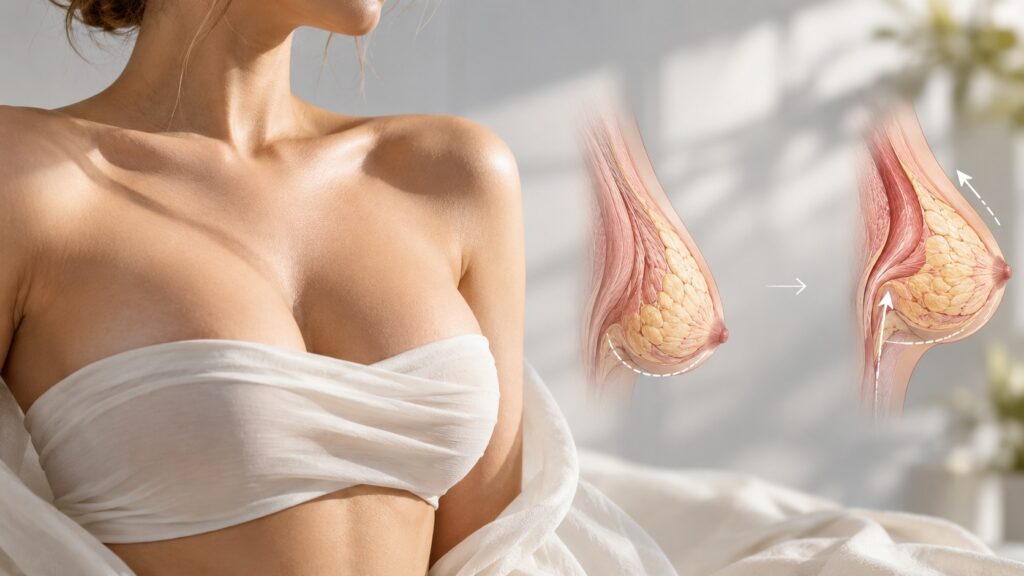
For women who want a fuller, more lifted breast shape but are uncomfortable with the idea of permanent foreign material in the body, that difference can matter. The real question is not simply “implant or no implant?” It is whether the breast already contains enough suitable tissue to create the shape, projection and support the patient expects.
What Does Implant-Free Breast Aesthetics Mean?
Implant-free breast aesthetics covers surgical approaches that improve breast shape without placing a silicone or saline implant. Depending on the patient’s anatomy and goals, existing tissue may be lifted, redistributed or used to create additional internal support and fullness.
This should not be confused with simply removing excess skin during a conventional breast lift. With techniques involving autoaugmentation or autoprosthesis, the breast tissue itself becomes part of the reshaping strategy.
What Is an Autoprosthesis?
In breast surgery, “autoprosthesis” refers to using the patient’s own tissue as a source of internal volume and support. Rather than adding a conventional implant, tissue that is already there is reshaped and moved to where it can contribute more effectively to the breast contour.
This can be particularly relevant when a woman has enough natural breast tissue, but that volume is no longer distributed where she would like it to be. Pregnancy, breastfeeding, ageing, gravity and significant weight changes can all leave more tissue in the lower breast while the upper part looks relatively empty.
Why Upper-Pole Fullness Is Often the Difficult Part
A breast lift and a breast augmentation address different problems. Mastopexy mainly deals with sagging and nipple position. Augmentation adds volume. In practice, though, many patients are looking for something between the two: they want the breast positioned higher, but they also do not want the upper part to remain flat or deflated.
That is where an implant-free approach may have a role. Instead of looking only at how much skin needs to be removed, the surgeon can also consider whether existing breast tissue can be moved and used to improve shape.
Using Lower-Pole Tissue Instead of Discarding Volume
In suitable patients, tissue from the lower part of the breast can be preserved and repositioned internally. Tissue that might otherwise be treated simply as excess can, in other words, become useful structural material.
One example is the Autoprosthesis approach described by PureOwn. In this technique, lower-pole breast tissue is repositioned into the subpectoral plane so the patient’s own tissue contributes to upper-pole fullness. The basic idea is easy enough to understand, even though the surgery requires careful anatomical planning: use available biological tissue where additional support and projection are needed rather than introducing an implant.
Breast Lift With Implants vs. Breast Lift Without Implants
There is no single answer that fits every patient. Existing breast volume, tissue quality, the degree of ptosis, the desired breast size and personal priorities all influence which approach may be considered.
| Consideration | Implant-Based Approach | Own-Tissue Approach |
|---|---|---|
| Source of additional fullness | Silicone or saline implant | Existing breast tissue |
| Foreign material | Yes | No implant |
| Ability to substantially increase size | Generally greater | Limited by available tissue |
| Natural tissue feel | Depends on implant, tissue coverage and anatomy | Volume consists of the patient’s own tissue |
| Suitability | Depends on anatomy and goals | Requires sufficient usable breast tissue |
The main limitation of an own-tissue technique is fairly straightforward. Existing volume can be redistributed, but the procedure cannot create unlimited new volume from tissue that simply is not there. A patient seeking a substantial increase in breast size may therefore have different options from someone whose main concerns are sagging and lost upper-pole fullness.
What Is the Dual-Plane Autoprosthesis Technique?
One technique in this field is Dual-Plane Autoprosthesis, also known as the Zereyak Autoprosthesis. It uses an inferior dermoglandular pedicle created from the patient’s own breast tissue. This tissue is positioned in the subpectoral plane, where the pectoral muscle contributes to internal support.
So this is more than simply folding tissue during a breast lift. The tissue is intentionally moved into another anatomical plane, with the aim of adding superior fullness while providing structural support.
PureOwn and the Own-Tissue Approach
pureown focuses on this implant-free approach and the Zereyak Autoprosthesis technique developed by Op. Dr. Umut Zereyak. The technique was reported in the peer-reviewed journal Aesthetic Plastic Surgery in 2026, with clinical outcomes from 47 patients and at least 12 months of follow-up.
For someone researching a relatively new surgical approach, published clinical evidence gives more to consider than a description of the technique alone. At the same time, a published patient series does not mean every patient will experience the same result. Broader comparative research and longer follow-up can provide a fuller picture as more evidence becomes available.
What Are the Potential Advantages of Avoiding Breast Implants?
The clearest difference is that there is no implant. As a result, implant-specific issues such as implant rupture, capsular contracture and future implant exchange are removed from the equation.
There are several other reasons why the concept may appeal to some patients:
- breast volume is created from existing natural tissue;
- no silicone implant is placed;
- upper-pole fullness may be improved in appropriately selected patients;
- breast lifting and own-tissue redistribution can be combined;
- the resulting breast remains composed of the patient’s own tissue;
- there is no implant that may require monitoring or replacement because of an implant-related problem.
Of course, “implant-free” does not mean “risk-free.” This is still surgery. Scarring, healing problems, asymmetry, changes in sensation, infection and other procedure-specific risks need to be discussed individually with a qualified plastic surgeon.
Who May Be a Candidate for Implant-Free Breast Reshaping?
Patient selection matters a great deal here. A technique may sound appealing in theory, but it only makes sense when it matches the patient’s anatomy and expectations.
Own-tissue breast reshaping may be considered when there is breast sagging, enough natural breast volume to work with and a desire to improve shape without silicone implants. It may also be relevant after pregnancy, breastfeeding or weight changes, particularly when fullness has been lost from the upper breast while usable tissue remains elsewhere.
When Might an Implant-Free Approach Be Less Suitable?
Very small breasts with little available tissue present an obvious limitation. If the goal is a substantial increase in overall breast size, simply rearranging the existing tissue may not create enough additional volume.
Expectations make a difference too. Someone looking for a very pronounced augmented appearance has a different goal from a patient who mainly wants a natural lift, moderate upper-pole fullness and no implants. Those two situations may call for different surgical strategies.
Does Implant-Free Mean No Scars?
No. Avoiding an implant does not mean avoiding surgical incisions.
When autoprosthesis is performed together with mastopexy, the scars are related to the breast-lift pattern required by the patient’s anatomy and degree of sagging. Their position and extent should therefore be discussed during surgical planning rather than assumed from the term “implant-free.”
How Natural Can the Result Look and Feel?
There is a simple reason own-tissue techniques attract interest: the redistributed volume is still natural breast tissue. Its softness and behaviour can therefore differ from volume created with a prosthetic device.
Still, “natural” means different things to different people. Breast width, skin quality, tissue density, starting volume and the amount of projection desired will all affect the final appearance. Looking at before-and-after photographs of patients with comparable anatomy can often tell you more than broad promises about how natural a procedure will look.
Can Results Last Without an Implant?
No breast operation can stop ageing, gravity or future changes in the body. Pregnancy, breastfeeding, major changes in weight and the natural loss of skin elasticity can alter breast shape after surgery, regardless of the technique used.
Own-tissue procedures can be designed with internal support in mind, but longevity still needs to be discussed realistically. “Permanent” should never be understood to mean that the breast will remain completely unchanged for life.
What Should You Research Before Considering Surgery?
A technique name, by itself, is not a good reason to choose surgery. What matters is how that procedure relates to your anatomy and whether it can realistically produce the result you have in mind.
These are some of the questions worth asking during a consultation:
- Do I have enough natural tissue for the result I want?
- How much upper-pole fullness can realistically be achieved?
- What scars would my anatomy require?
- How does this approach differ from a conventional mastopexy?
- What are the surgical risks and possible complications?
- How could pregnancy or weight change affect the result?
- What alternatives should I consider?
- Are there published clinical results for the proposed technique?
If avoiding implants is already one of your priorities, a dedicated resource on Implant-Free Breast Aesthetics can help you understand how own-tissue techniques work and what surgeons consider when assessing patient suitability. It cannot replace an examination, though. Individual anatomy still has to be evaluated before deciding whether this approach, or another one, makes sense.
Making an Informed Choice About Breast Aesthetics
Interest in implant-free breast surgery reflects a fairly simple question many patients now ask: can my own anatomy be used before a foreign material is added?
For the right candidate, tissue that might otherwise be reduced or simply reshaped may instead contribute to upper-pole volume and internal support. Another patient may find that an implant or a different procedure fits her goals better. There is no universal solution here.
A more useful starting point is to define the result you actually want, understand how much usable tissue you have and discuss what can realistically be achieved with an appropriately qualified plastic surgeon.
Frequently Asked Questions
What does autoprosthesis mean in breast surgery?
Autoprosthesis generally means using and reshaping the patient’s own breast tissue to provide internal volume or support rather than relying solely on a synthetic implant.
Can breast volume be created without silicone implants?
Yes, in selected patients. Existing breast tissue can be redistributed to improve shape and fullness, although the amount of volume that can be achieved depends on how much suitable tissue is already present.
Is autoprosthesis the same as a breast lift?
No, not exactly. A breast lift mainly corrects sagging and repositions the breast. Autoprosthesis techniques deliberately use existing tissue to contribute to internal volume and support. The two can be performed together.
Who is a good candidate for implant-free breast aesthetics?
Potential candidates generally have enough natural breast tissue, some degree of sagging or upper-pole volume loss and a preference to avoid implants. Whether someone is actually suitable requires an individual surgical assessment.
Can very small breasts be enlarged using only their own tissue?
Only to a limited extent when very little tissue is available. A significant increase in size usually cannot be produced simply by redistributing breast tissue that is not already there.
What is upper-pole fullness?
Upper-pole fullness is the volume in the upper part of the breast above the nipple. It can decrease after pregnancy, breastfeeding, weight loss or ageing, sometimes leaving the breast with a flatter or deflated appearance.
Does implant-free breast surgery leave scars?
Yes, it can. If the operation includes mastopexy, the scars depend on the incision pattern needed to lift and reshape the breast.
Can breasts sag again after an implant-free lift?
Yes. Breast shape can continue to change with age, gravity, pregnancy, breastfeeding and weight fluctuations, just as it can after other types of breast-lift surgery.
What is Dual-Plane Autoprosthesis?
It is an own-tissue breast reshaping approach in which a dermoglandular tissue segment is repositioned into the subpectoral plane to contribute to upper-pole volume and internal support.
Is implant-free breast surgery safer than having implants?
Avoiding implants removes implant-specific complications, but the operation itself still carries surgical risks. The overall risk profile depends on the procedure, the patient’s health and anatomy, and the surgical plan.
How do I know whether an implant or my own tissue is better for me?
That depends on your existing breast volume, degree of sagging, skin and tissue quality, desired size and aesthetic goals. An individual examination and consultation with a qualified plastic surgeon are needed to determine which options fit those factors.
What should I ask during an implant-free breast surgery consultation?
Ask about your candidacy, realistic volume and shape, scars, recovery, risks, alternatives and likely long-term changes. It is also reasonable to ask about the surgeon’s experience with the proposed technique, relevant before-and-after cases and any published clinical evidence.
What is your reaction to this?
 I liked it
 Wonderful
 Thanks
 Good
Good Hahaha !
 Incredible
 Interesting
 Wrong
Wrong